One WhatsApp message at the end of the day is enough: the folio is recorded, sequential and with both signatures, and progress against plan is computed on its own.
The site engineer answers on WhatsApp, the day is entered in the shape of the official form and the supervising engineer signs it under their licence. Nobody re-types anything.
9:41
01 Nothing to install: the site engineer sends the daily log over WhatsApp
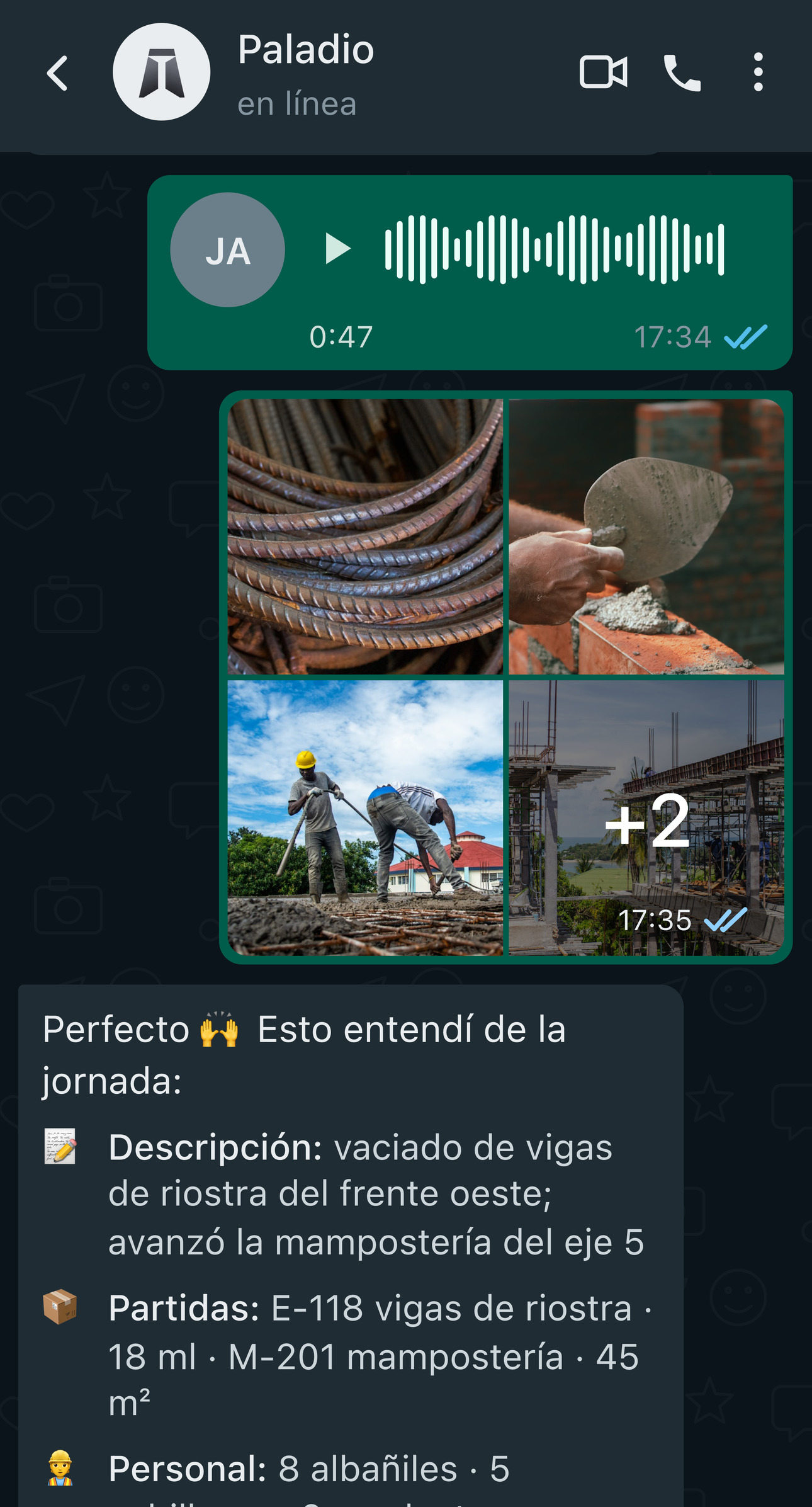
Eva, Paladio’s Concierge, asks over WhatsApp what the daily control sheet requires —activities per line item, crew, weather, quality— and the engineer answers the way he speaks: voice notes and photos from the front.
Voice is transcribed: every recorded quantity has its word-for-word backing.
Photos are pinned to the day’s line item, not loose in a camera roll.
If a figure looks off —45 m² where the usual pace is 28— Eva flags it for the inspector.
9:41
02 A real bound logbook: sequential and gapless
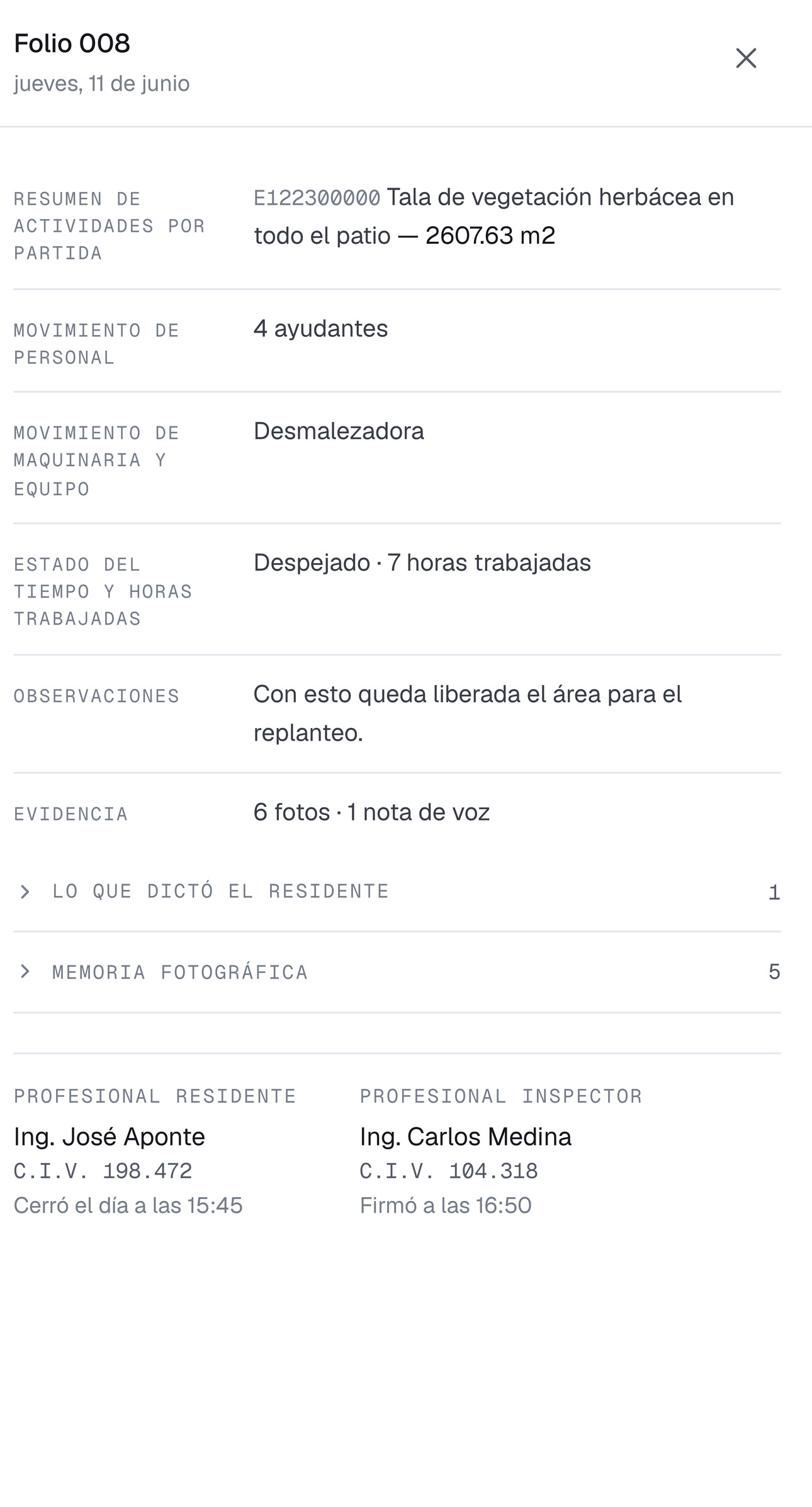
Each day is recorded with the shape of the site logbook: folio number, answered boxes, evidence and both signatures. A day with no activity is recorded too — the book has no gaps to explain later.
The full sheet: crew, machinery, weather, quality control, remarks.
The transcript and the photo record live inside the folio they support.
From the budget you reach the folio behind every figure — and back.
9:41
03 Signing is a licensed act, not a click
The inspector approves or objects with a one-time code sent to their WhatsApp. The folio is sealed with their license number, the time and the evidence — and an objection says what to fix, not just “objected”.
Licensed identity: the signature carries the license number under the name, like the paper sheet.
A signed folio becomes read-only: the file is never rewritten.
Objections carry the line item and reasons, kept as the inspector’s comment on file.
A real bound logbook: sequential and gapless
Each day is recorded with the shape of the site logbook: folio number, answered boxes, evidence and both signatures. A day with no activity is recorded too — the book has no gaps to explain later.
The full sheet: crew, machinery, weather, quality control, remarks.
The transcript and the photo record live inside the folio they support.
From the budget you reach the folio behind every figure — and back.
THE READING
Progress against plan comes out of the diary by itself
Each folio contributes its quantities and Paladio turns them into financial reading: progress against plan, where the money goes —materials, labor, equipment— and how much material is consumed, in bags and cubic metres, not just in dollars.
Progress against plan corrects itself with every diary received: nobody retypes into Excel.
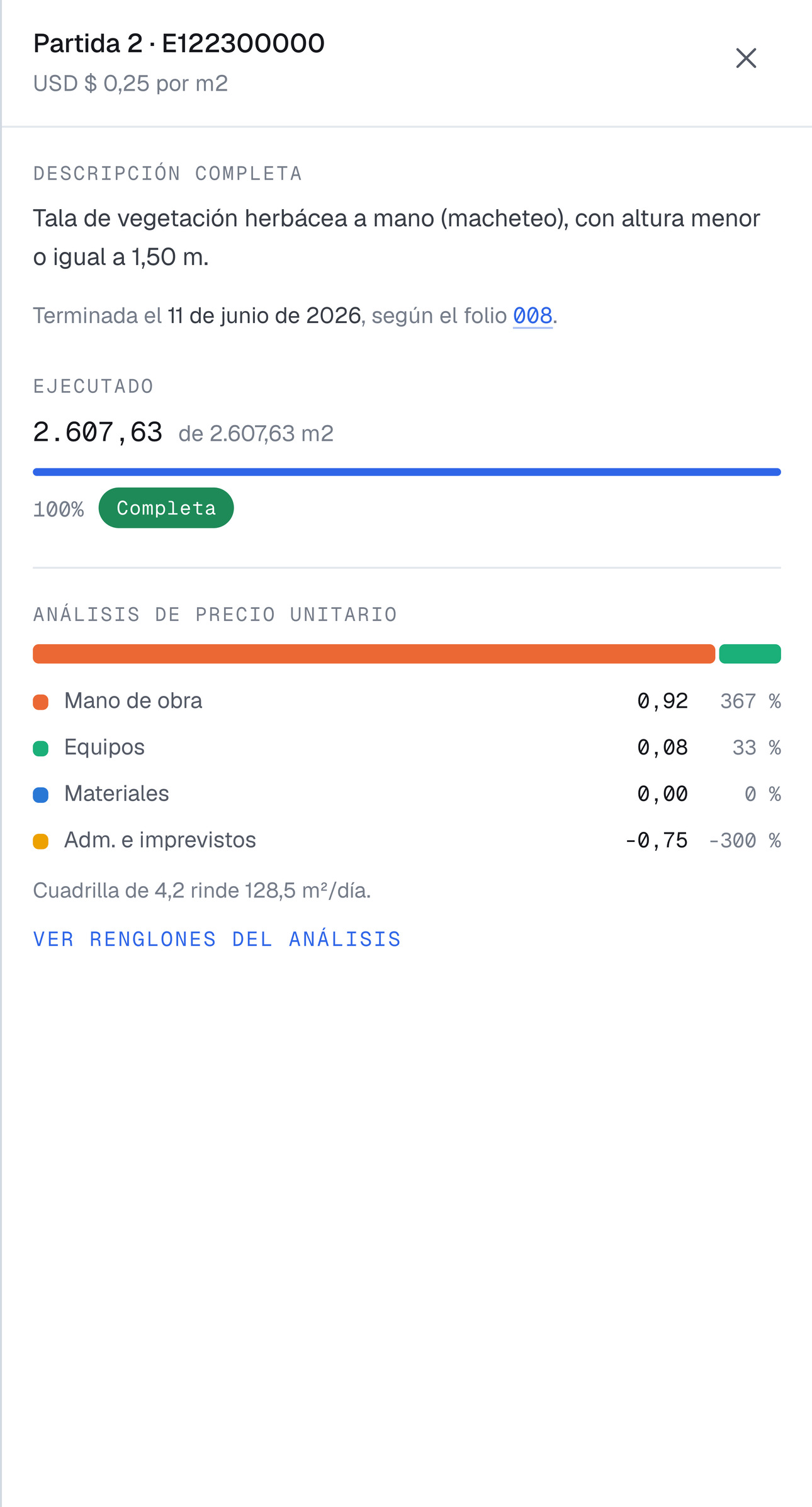
Cost composition comes from each line item’s unit price analysis.
Materials in real quantities — the list you negotiate purchases with.
PROGRESS AGAINST PLAN — OVERVIEWExecutedPlanned
USD 20.6 M executedUSD 2.1 M behind plan · 91%
Every point comes from the logbook folios — nobody typed this chart.
THE PLAN
A schedule that knows what each day costs
Crews, machinery and materials for each activity come from the unit price analysis — the live cost sheet with its production rates. Each bar’s duration is quantity over rate, not a drawing.
Line items with their catalog code and full unit price analysis: materials, equipment, labor.
“540 m² of masonry at 28 m²/day” — the Gantt shows the math that keeps it honest.
The late activity flags itself by comparing executed against expected today.
DELIVERABLES & SCHEDULE — METROPOLITAN STADIUM
Slab pour — Level 22026-08-12
ON PLAN
Precast stands erection2026-09-30
AT RISK
Ring roof — West stand2026-11-15
6 D BEHIND
ESTIMATED FINISH 2027-03-22 · +9 days vs. contract
Frequently asked questions
Does the site engineer have to install anything?
No. Eva, Paladio’s Concierge, lives in WhatsApp: the engineer messages the project’s number and answers the sheet’s questions with text, voice notes or photos. The app is for reviewing, signing and reading metrics — capture happens in the chat already in his hand.
Does this count as a site logbook?
The folio replicates the daily control sheet of the bound logbook: sequential gapless numbering, the paper’s boxes and both signatures —resident and inspector— with their license numbers. Every approval is sealed with identity, time and evidence.
What if the engineer reports a quantity that doesn’t add up?
Eva compares against the budget and historical production rates and flags it for the inspector before signing: “masonry logged 45 m² today against a usual pace of 28”. The decision stays with the inspector; Eva only says where to look.
Where do the financial charts come from?
From the folios and each line item’s unit price analysis. When a diary is recorded, progress against plan, cost composition and material consumption recompute themselves. No chart is ever typed in.
What if the project has no unit price analyses loaded?
The logbook works the same: folios, signatures and physical progress. Unit price analyses can be uploaded later —one by one or per chapter— and the financial metrics switch on with them.